
How children develop good character is about much more than simply getting them to behave when an adult is watching.
As parents and teachers, we want children to listen, show respect, tell the truth, work hard and keep going when things become difficult.
But there is a question that I think is even more important:
Why are they doing it?
Imagine two children standing perfectly still while their teacher is talking. They look identical. Both are quiet. Both are listening. Both appear to be showing excellent behaviour.
But one child might be thinking: “I’d better listen or I’ll get into trouble.”
While the other is thinking: “I listen when somebody is speaking because that’s the kind of person I am.”
The behaviour might look exactly the same from the outside. But what’s happening on the inside is completely different.
And that is the idea behind something we teach at Champions Character in Churchdown, Gloucester called The Behaviour Pyramid. It gives parents and children a simple way to understand how children develop good character as motivation gradually moves from the outside to the inside.
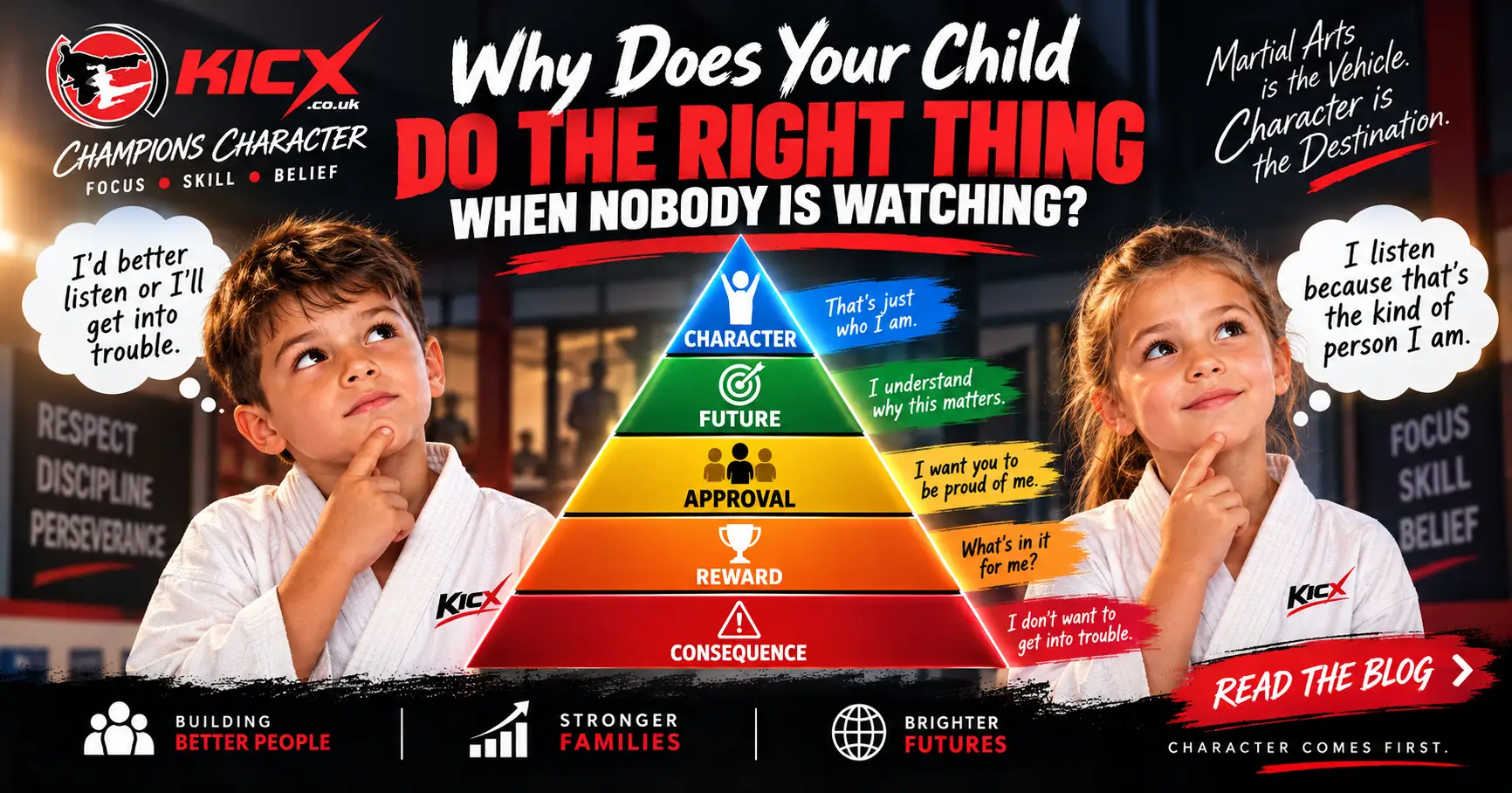
How Children Develop Good Character: The Five Levels
The Behaviour Pyramid has five stages:
CONSEQUENCE → REWARD → APPROVAL → FUTURE → CHARACTER
Children don’t suddenly arrive at the top. They develop. Rules, boundaries, rewards, praise and encouragement can all play an important part in helping a child learn. The aim is to gradually help children need those external influences less and less, until making the right choice begins to come from within.
1. Consequence — “I don’t want to get into trouble.”
This is often where development begins. A child listens because the teacher might correct them. They stop doing something because Mum or Dad has told them to stop. They follow the rule because they know there will be a consequence if they don’t.
That’s not a bad thing. Children need clear boundaries. They need to learn that choices have consequences. But if the only reason a child makes the right choice is because an adult is standing there watching them, we haven’t reached character yet.
2. Reward — “What’s in it for me?”
Now the child begins to associate good choices with positive outcomes. In martial arts, perhaps they practise because they want their next stripe. They focus because they want praise. They work hard because they want their next belt or medal.
Rewards can be incredibly useful, particularly with younger children. But instead of simply saying, “Here’s your sticker,” we can begin connecting that reward to why they earned it: “You earned that because you kept trying even when it was difficult. That’s perseverance.”
Suddenly we’re not just rewarding behaviour. We’re giving that behaviour a name. And we’re beginning to build character.
3. Approval — “I want you to be proud of me.”
Children naturally want the people they respect to be proud of them. They want Mum or Dad to notice. They want their teacher to notice. And yes, our students often want Master T to be proud of them!
That relationship can be enormously powerful. But we can gradually change the conversation. Instead of always saying “I’m proud of you,” we can start saying “You should be proud of yourself.” And eventually: “Why are you proud of yourself?”
Now something important is happening. The child has to think about their own behaviour rather than simply waiting for somebody else to judge it.
4. Future — “I understand why this matters.”
This is where we begin to see a major change. The child starts connecting what they do today with who they could become tomorrow.
They practise because they understand practice makes them better. They listen because they understand that if they focus, they can learn. They persevere because they begin to understand that doing difficult things makes them stronger.
What I do today → Who I become tomorrow.
That’s a huge lesson for a young person to learn, because now they’re beginning to take ownership of their own development. Research on child development also shows that skills such as focus, self-control and planning are developed through practice and supportive experiences; the Center on the Developing Child at Harvard University explains how executive function and self-regulation skills develop.
5. Character — “That’s just who I am.”
This is the destination — and the reason we care so much about how children develop good character.
- “I listen because I’m a good listener.”
- “I don’t give up because I’m someone who keeps trying.”
- “I tell the truth because I’m an honest person.”
- “I show respect because I’m respectful.”
- “I help people because that’s the kind of person I am.”
Nobody needs to offer them a sticker. Nobody needs to threaten a consequence. Nobody even needs to be watching.
And that, for me, is the crucial difference between obedience and character.
Obedience can disappear when the authority figure leaves the room. Character goes with the child.
So Where Is Your Child on the Behaviour Pyramid?
The answer probably isn’t one level. A child could be at Character in one part of their life and Consequence in another.
They might tidy their bedroom only because Mum is threatening to take the iPad away! Yet that same child might see another child fall over at school and immediately stop to help them, without anybody asking.
That’s normal. Character develops over time. Understanding how children develop good character means looking at the reason behind a choice, not simply whether the behaviour looked good from the outside.
So rather than using the pyramid to label children, we use it to help them think. We can ask:
- “Why did you make that choice?”
- “Where do you think you are on the pyramid?”
- “What would the next level look like?”
- “Did you do that because somebody was watching, or because that’s the person you’re becoming?”
This idea connects closely with the way we teach children to recognise the power of their choices and to become increasingly responsible for the decisions they make.
Why Character Development Matters in Children’s Martial Arts
Of course we teach children how to kick, punch, block and move. But that’s the easy bit.
A front kick gives us an opportunity to teach Focus. Practising that front kick develops Skill. Repeating it, improving it and eventually mastering it develops Belief.
But behind all of that we’re trying to develop something even more important: Character.
That’s why our mission at Kicx is about far more than martial arts technique. You can read more about what we really teach through Champions Character.
We don’t simply want children who behave well when Master T is standing in front of them. We don’t simply want children who work hard because there’s another belt coming. We want to help develop young people who understand their choices and eventually make the right choice because that’s the person they have chosen to become.
Helping Children Develop Good Character in Gloucester
At Champions Character and Kicx in Churchdown, Gloucester, martial arts is the vehicle we use to help children practise these lessons in the real world: listening when they’re excited, persevering when something is difficult, showing respect, taking responsibility and learning to make better choices.
For us, how children develop good character isn’t an abstract idea. It is something they can practise lesson by lesson, choice by choice.
Maybe some of that sounds a little traditional.
And that’s okay — because we believe traditional values still matter.
Hard work. Respect. Discipline. Perseverance. Taking responsibility. And learning that sometimes the things that are difficult are the very things that help us grow.
At Champions Character, your child’s development comes first.
We want them to enjoy coming here. We want them to have fun. But most importantly, we’re going to challenge them, encourage them and help them become the very best version of themselves.
So, if you’re looking for children’s martial arts in Gloucester where traditional values still matter, where character comes first, and where your child will be challenged to become someone you can be incredibly proud of, come and experience Champions Character for yourself.
Come and take a trial with us.
Martial arts is the vehicle. Character is the destination.
Character Comes First.
— Master T — The Karate Kid Teacher
One More Thing…
Character Comes First.
Your child becomes like the people they spend time with. Choose the tribe that builds them up.