
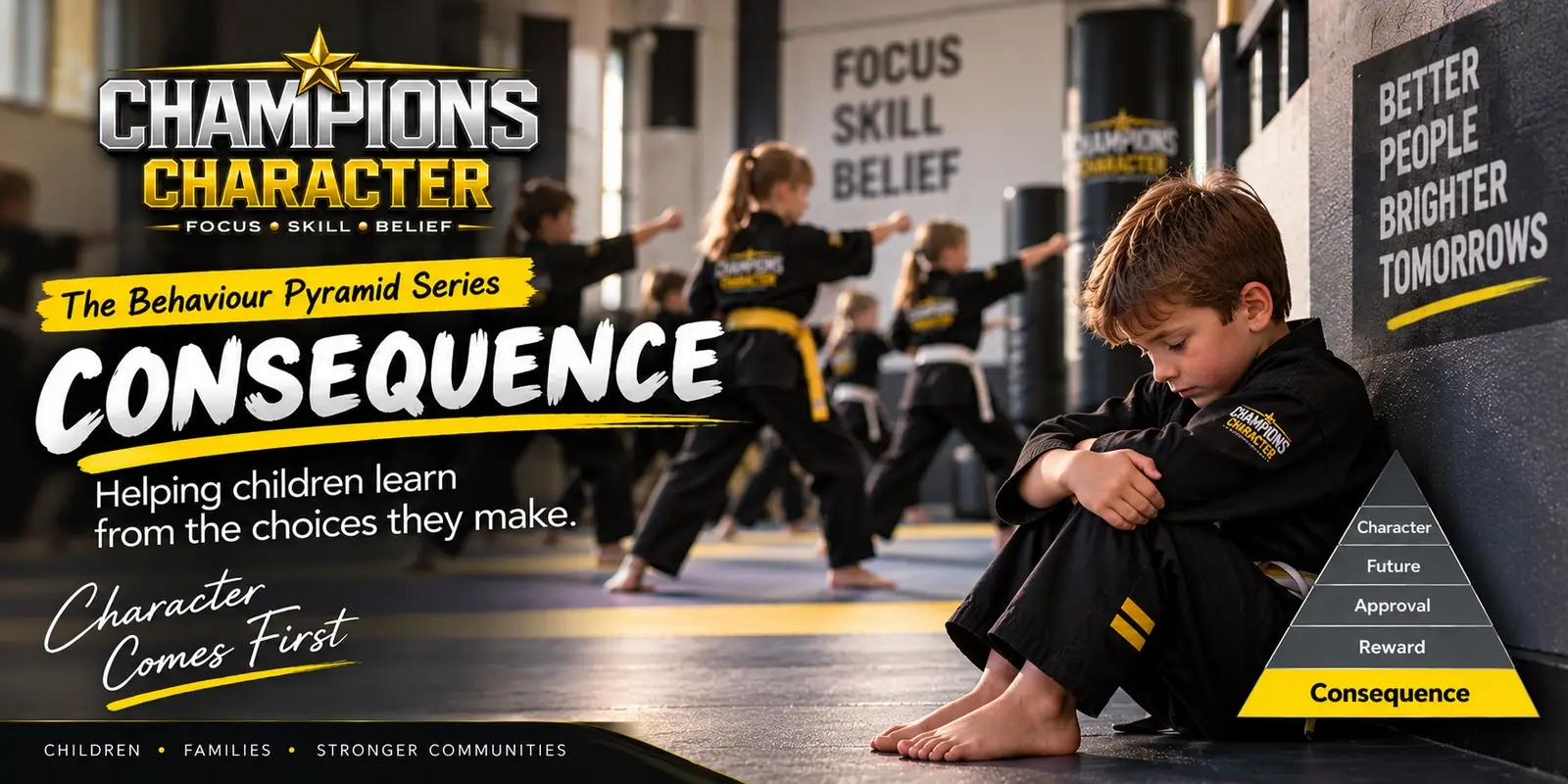
Imagine I ask ten children in one of our classes to sit down, be quiet and listen.
All ten sit down.
From the outside, they look exactly the same: ten children doing the right thing.
But if we could hear what each child was thinking, we might discover something very different.
One child might be thinking:
“I’d better listen because I don’t want to get into trouble.”
That child is at the first level of our Champions Character Behaviour Pyramid: Consequence.
And here’s the important part: that child is doing well.
The Behaviour Pyramid Looks at WHY a Child Does the Right Thing
The Behaviour Pyramid is not simply a scale from a naughty child to a well-behaved child. Every child who is on the pyramid is already beginning to make positive choices.
What changes as they climb is the motivation behind those choices.
At Level 1 — Consequence — the child does what has been asked because they don’t want the negative consequence of choosing otherwise.
They sit down when asked. They listen. They follow the rules. They complete what they have been asked to do.
The behaviour can be absolutely correct.
It’s the reason for that behaviour that places them at Level 1.
“I Do It Because I Don’t Want to Get Into Trouble”
This is probably the simplest way to understand Consequence.
A child may think:
- “I’ll listen because I don’t want to be told off.”
- “I’ll behave because I don’t want to sit out.”
- “I’ll tidy my things because I don’t want Mum or Dad to be cross.”
- “I’ll follow the rule because I don’t want to lose a privilege.”
In every example, notice what the child is actually doing.
They’re making the better choice.
That’s why Consequence shouldn’t automatically be viewed negatively. The child is beginning to control their actions because they understand that choices have outcomes.
There Is Almost a Level Zero
Although our Behaviour Pyramid officially begins at Consequence, I sometimes describe another stage underneath it as Level Zero.
That’s when a child isn’t yet motivated by the consequence at all.
They know they may have to sit out, but they don’t care. They know they may lose a privilege, but at that moment it makes no difference to their decision. They simply continue with the behaviour.
That child isn’t really on the Behaviour Pyramid yet.
So when a child reaches the stage where they think, “I don’t want that to happen, so I’m going to make the right choice,” something important has happened.
They have started to regulate their own behaviour.
It may be the bottom of the pyramid, but they are on the pyramid.
The Same Behaviour Can Come From Five Different Motivations
This is what makes the Behaviour Pyramid so useful.
Imagine five children are asked to stop talking and listen to their teacher. All five immediately become quiet.
From the outside, we see exactly the same behaviour.
But inside, their thinking could be completely different:
Consequence: “I’ll listen because I don’t want to get into trouble.”
Reward: “I’ll listen because I want to earn something.”
Approval: “I’ll listen because I want my teacher or parents to be proud of me.”
Future: “I’ll listen because I know this will help me learn and improve.”
Character: “I’ll listen because it’s the right thing to do.”
Same instruction. Same outward behaviour. Five very different reasons.
Our goal isn’t simply to get children to behave. It’s to help them gradually develop a stronger reason for choosing good behaviour.
Consequence Is a Starting Point, Not the Destination
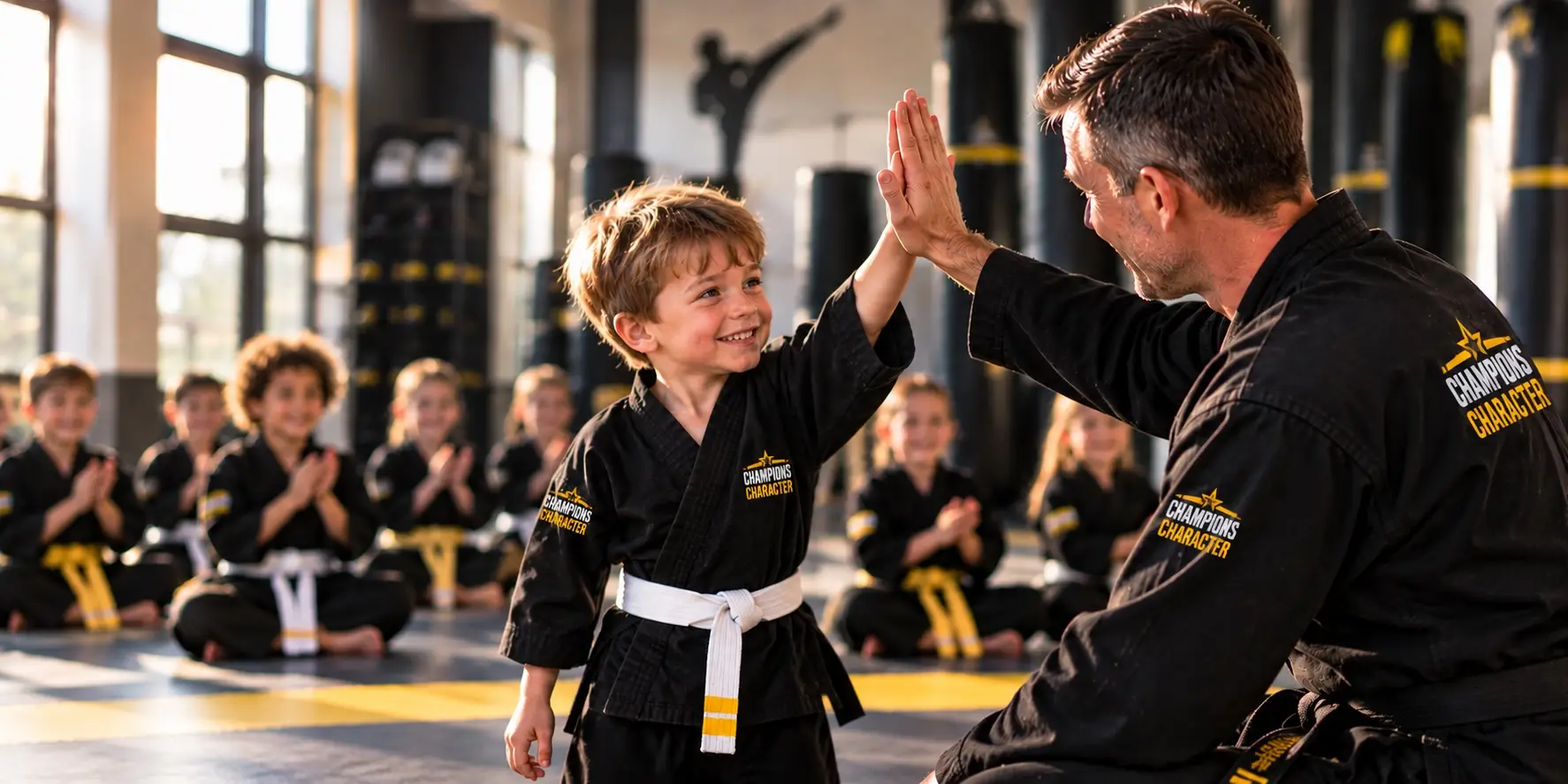
If a child is behaving because they don’t want to get into trouble, we shouldn’t dismiss that.
They’ve already made an important connection:
My choices matter.
They are learning to stop, think and make a decision.
But we don’t want children to remain dependent on consequences forever.
Why?
Because eventually the adult isn’t going to be there.
Mum won’t always be watching. Dad won’t always be beside them. Their teacher won’t always be in the room.
As children get older, they will face more and more decisions that they have to make for themselves.
That’s why we want to help them climb.
Helping Children Move Up the Behaviour Pyramid
At Champions Character, we use martial arts as a vehicle for teaching these lessons because training gives children countless opportunities to practise making choices.
Do I listen when my teacher is talking?
Do I keep trying when something is difficult?
Do I show respect to my training partner?
Do I control myself when I’m excited?
At first, a child may make those choices because they don’t want the consequence of doing otherwise.
That’s okay.
Our job is to help them develop beyond that.
Through repetition, guidance and experience, their motivation can gradually move from Consequence → Reward → Approval → Future → Character.
What Parents Can Look For
Rather than only asking, “Did my child do what they were told?”, occasionally ask another question:
“Why did they choose to do it?”
That question tells us much more about where the child is developmentally.
And if the answer is, “Because they didn’t want to get into trouble,” don’t assume that’s failure.
They’re doing the right thing.
They’re beginning to control their choices.
They’re on the first step.
Now we help them climb.
Character Comes First
At Champions Character in Churchdown, Gloucester, martial arts is not simply about learning punches, kicks, blocks and stances.
We use martial arts to help children develop Focus, Skill and Belief — and to give them opportunities to practise making good choices over and over again.
Ultimately, we want to help children reach a point where their behaviour is no longer controlled primarily by consequences, rewards or even the approval of other people.
We want them eventually to be able to say:
“I do the right thing because it’s the right thing to do — even when nobody is watching.”
That’s character.
And children don’t arrive there overnight.
They climb there.
Martial arts is the vehicle. Character is the destination.
Character Comes First.
With respect,
Master T
The Karate Kid Teacher
Stephen Thompson
Former World & European Karate Champion
7th Dan Wado-Ryu Karate & Kickboxing
Champions Character
Focus • Skill • Belief
Martial arts is the vehicle. Character is the destination.
Character Comes First.